

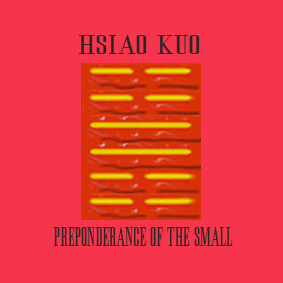
62. Hsiao Kuo; Preponderance of the Small Above; Chen the Arousing thunder Below; Ken Keeping Still mountain |
21st Century |
Comparisons |
| Thunderous great changes hide
the minutiae which went into creating them. Everything is in the details.
A novelist successfully creates an alternate world through the steady application of detail. The credentials of an authority in any subject rest on their knowledge of details. The success of any business manager is in their knowledge of the details of their business. These are all imponderably important understandings. The little things constituting the big things. This is as true in physics and chemistry as it is in philosophy. A household managed by people without an eye to detail is untidy, even unwholesome. A relationship carried on without an eye to the aspirations of the participants is flawed in detail even though outwardly appearing strong. Small things, the imponderably small things which make up a day, the various jobs, and people, the relationships and obligations, all these details need to be understood in their relationship to the whole; meaning the goal. The time invested in each element should not be out of proportion to its role in maintaining the common welfare. Yet, paradoxically, apportioning its due is crucial in the maintenance of the whole. A stitch in time. Hazards are hidden in the details. A new endeavour can fall over for the missing of a few details. Learning may take longer than expected. Impatience will cause problems. Like a good engineer who knows every nut and bolt in their machine, they know when to stop and rest the engine because some of the parts are stressed. These things lead to stability, prosperity, and little down time due to breakdowns. Its not how you start but how you finish. And, with the help of the details, not in spite of the details, you will have succeeded in a harmonious victory.
|
Line 1 |
Below are the comparative interpretations of a) Legge, b) Willhelm, c) Riefler, d) Crowley
a) (the idea of) a bird flying, (and ascending) till the issue is evil.
b) The bird meets with misfortune through flying.
c) The skylark flies too high. Ominous.
d) The issue's evil when birds soar too high:
a) passing by his grandfather and meeting with his grandmother; not attempting anything against his ruler, but meeting him as his minister. There will be no error.
b) She passes by her ancestor And meets her ancestress. He does not reach his prince And meets the official. No blame.
c) The woman bypasses her father and meets her mother. The man bypasses the ruler and meets the minister. No mistakes.
d) The wisest course is humble loyalty.
a) taking no extraordinary precautions against danger; and some in consequence finding opportunity to assail and injure him. There will be evil.
b) If one is not extremely careful, Somebody may come up from behind and strike him. Misfortune.
c) The man has taken no precautions; others take advantage of this. Ominous.
d) Men by incaution ask their foes to assail;
a) falling into no error, but meeting (the exigency of his situation), without exceeding (in his natural course). If he go forward, there will be peril, and he must be cautious. There is no occasion to be using firmness perpetually.
b) No blame. He meets him without passing by. Going brings danger. One must be on guard. Do not act. Be constantly persevering.
c) The man successfully plays it by ear. Advance boldly, but with caution.
d) Tact and adroitness help one to prevail.
a) dense clouds, but no rain, coming from our borders in the west. It also (shows) the prince shooting his arrow, and taking the bird in a cave.
b) Dense clouds, No rain from our western territory. The prince shoots and hits him who is in the cave.
c) Heavy clouds from the west, but no rain. The prince shoots an arrow into the cave and hits a bird.
d) Birds in a cave - sure marks for archer's eye!
a) not meeting (the exigency of his situation), and exceeding (his proper course). (It suggests the idea of) a bird flying far aloft. There will be evil. The case is what is called one of calamity and self-produced injury.
b) He passes him by, not meeting him. The flying bird leaves him. Misfortune. This means bad luck and injury.
c) The skylark flies too high. The man exceeds his limit. Self-destruction. Ominous.
d) Ambition, in bad times, is lunacy.