

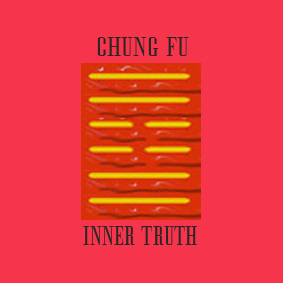
61. Chung Fu; Inner Truth Above; Sun the Gentle wind,wood Below; Tui the Joyous lake |
21st Century |
Comparisons |
| The inner truth of things is the grail of
all quests.
To describe inner truth by its attributes seems profane, to describe it by what it is not is more approachable. Cruelty and greed are inexcusable. In cruelty and greed there is no inner truth. No argument or suasion will justify cruelty and greed. Almost everything else carries elements mitigating responsibility. The healing power of love has within it a truth. Love and compassion are proactive. They open the door to integration and peace. All human relationships are profoundly changeable. This is unavoidable. To find calmatives, to anticipate the troubles before they come is the mark of good management. To enact procedures, to listen to advice and be open to new methods these are the marks of cohesion. Structures with integrity are stable, long lived. The inner truth in all things is that words will never be enough. Words can salve, words can in some cases heal, but without the actions, the deeds, the plan, and the vision it all amounts to conjugations of grammatical forms. What is sensible is something built well, reasoned, rational. Useful. The purpose of such a thing is to improve the lives of all, to ease the way of as many as possible, and to assist in cultivating good. If you cannot believe in it even if it makes sense and works then it is still not satisfying something at a spiritual level. Only when it can be believed does the thing become relevant. To strive for this will bring fortune.
|
Line 1 |
Below are the comparative interpretations of a) Legge, b) Willhelm, c) Riefler, d) Crowley
a) resting (in himself). There will be good fortune. If he sought to any other, he would not find rest.
b) Being prepared brings good fortune. If there are secret designs, it is disquieting.
c) The man rests in himself. if he were to seek outside of himself he could not rest. Auspicious.
d) Trust thou thyself, repose in thine own sphere enclosed.
a) (like) the crane crying out in hidden retirement, and her young ones responding to her. (It is as if it were said), "I have a cup of good spirits," ( and the response were), " I will partake of it with you."
b) A crane calling in the shade. Its young answers it. I have a good goblet. I will share it with you.
c) The crane among the reeds calls and her young respond. "I have some delicious morsels here." "We'll share them with you."
d) But welcome and reciprocate good cheer.
a) having met with his mate. Now he beats his drum, and now he leaves off. Now he weeps and now he sings.
b) Her finds a comrade. Now he beats his drum. Now he stops. Now he sobs. Now he sings.
c) The man meets his mate. Now he beats the drum. Now he stops. Now he weeps. Now he sings.
d) A mate involvers vicissitudes that very:
a) (like) the moon nearly full, and (like) a horse ( in a chariot) whose fellow disappears. There will be no error.
b) The moon nearly at the full. The team horse goes astray. No blame.
c) The moon is nearly full. Only one horse breaks his traces; one horse remains. No mistakes.
d) He travels fast who travels solitary!
a) Perfectly sincere, and linking (others) to him in closest union. There will be no error.
b) He possesses truth, which links together.
c) The man possesses self knowledge and joins closely with others. No mistakes.
d) Men are most loyal to men most sincere:
a) In chanticleer (trying to) mount to heaven. Even with firm correctness there will be evil.
b) Cockcrow penetrating to heaven. Perseverance brings misfortune.
c) Chanticleer mounts to heaven. Ominous.
d) But failure's for sky-soaring chanticleer!