
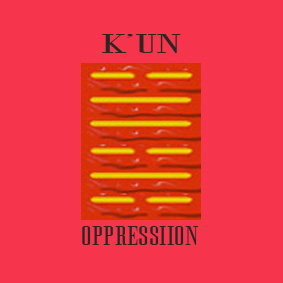
47. K'un; Oppression Above; Tui the Joyous lake Below; K'an the Abysmal water |
21st Century |
Comparisons |
| Oppression by reversals, by inclemencies
can destroy one if one is weak and cannot see the opportunity each moment
offers. Opportunity for improvement exists so long as one takes it.
Adversity holds within it the seeds of success.
Drought can destroy an unprepared farmer. Knowing there will be an end to the drought assists in surviving it intact. An enterprise needs a steady hand to guide it through an adverse period. The power patience is always being understated. Responding to the negatives, allowing the setbacks to leach away ones resolve leads to errors in judgement and confusion. You can only send clear signals if you know exactly what you want to say. Permitting oneself the luxury of depression ill becomes one and does little to remedy the situation. Stalwartness, belief in a method or faith or whatever, which makes sense and is useful to people centres one from wasting their energy on procrastination. One can be oppressed by ones own success, especially if it came too easily, or one is too material. The obligations of property may take one off course, and this regrettable, however nothing is lost so long as one remembers that the way forward is through service. This opens one to love, this opens the mind to many possibilities beyond merely the self. Oppression comes when one forgets the simple in favour of the overly complex or cushioned. |
Line 1 |
Below are the comparative interpretations of a) Legge, b) Willhelm, c) Riefler, d) Crowley
a) with bare buttocks straitened under the stump of a tree. He enters the dark valley, and for three years has no prospect (of deliverance).
b) One sits oppressed under a bare tree And strays into a gloomy valley. For three years one sees nothing.
c) Confined beneath a fallen tree in a dark valley for three years.
d) Bare buttocks- tree-stump-valley-hopes decay.
a) straitened amidst his wine and viands. There come to him anon the red knee-covers (of the ruler). It will be well for him (to maintain his sincerity as) in sacrificing. Active operations (on his part) will lead to evil, but he will be free from blame.
b) One is oppressed while at meat and drink. The man with scarlet knee-bands is just coming. It furthers one to offer sacrifice. To set forth brings misfortune. No blame.
c) Confined at the dinner table. When authorities come he remains pious and respectful. Ominous if you take the initiative; but without blame.
d) Embarrassed king, be quiet and sincere!
a) straitened before a (frowning) rock. He lays hold of thorns. he enters his palace, and does not see his wife. There will be evil.
b) A man permits himself to be oppressed by stones, and leans on thorns and thistles. He enters his house and does not see his wife. Misfortune.
c) Confined by a rock, the man grasps at briers. In his palace, he does not see his wife. Ominous.
d) Rocks-thorns-come home, and find thy wife astray -
a) proceeding very slowly (to help the subject of the first line), who is straitened by the carriage adorned with metal in front of him. There will be occasion for regret, but the end will be good.
b) He comes very quietly, oppressed in a golden carriage. Humiliation, but the end is reached.
c) Confined in chrome in a slow procession. Some regrets. Auspicious in the end.
d) Even with friends the course is hard to steer.
a) with his nose and feet cut off. He is straitened by (his ministers in their) scarlet aprons. He is leisurely in his movements, however, and is satisfied. It will be well for him to be (as sincere) as in sacrificing (to spiritual beings).
b) His nose and feet are cut off. Oppression at the hands of the man with purple knee bands. Joy come softly. It furthers one to make offerings and libations.
c) Confined by traitors. His nose and feet are cut off. He takes it calmly and accepts his fate. he remains pious and respectful.
d) Rebellion? Honesty has naught to fear.
a) straitened, as if bound by creepers; or in a high and dangerous position, and saying (to himself), "If I move I shall repent it." If he do repent of former errors, there will be good fortune in his going forward.
b) He is oppressed by creeping vines. he moves uncertainly and says, "Movement brings remorse." If one feels remorse over this and makes a start, Good fortune comes.
c) Confined by ivy on the edge of the cliff he tells himself, "If I move I will regret it." Repent what has gone before, then act. Auspicious.
d) Bound? On the brink? Repent, and take thy way!