
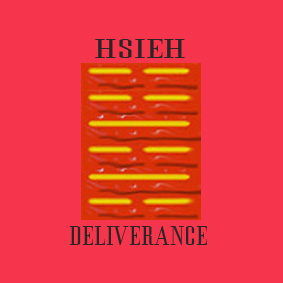
40. Hsieh; Deliverance Above; Chen the Arousing thunder Below; Chen the Arousing thunder |
21st Century | Comparisons |
| An obstacle is removed and there is a sudden change in the
state of affairs. It may take an electrifying outburst to clear the air
but the result will be beneficent to growth.
To carry your own burden is part of being one of the ordinary while wealth buys its own prerogatives. The appointment of deputies to do what you should do creates a group of people who are like foxes waiting for you to weaken. The yellow signifies the middle path and the arrows signify the straight and narrow.. Conspicuous consumptions serves only to make you a target to brigands and beggars. The wise flaunt nothing. The hunting theme persists, as the use of arrows persists. Implying that steadiness and a clear eye will remove the obstructions posed by that confederacy of dunces arrayed against you. |
Line 1 |
Go to topBelow are the comparative interpretations of a) Leg ge, b) Willhelm, c) Riefler, d) Crowley
a) will commit no error.
b) Without blame.
c) No mistakes. Feel no guilt at being singled out by fortune.
d) Begin to loosen - straight and clear the way.
a) catch, in hunting, three foxes, and obtain the yellow (=golden) arrows. With firm correctness there will be good fortune.
b) One kills three foxes in the field And receives a yellow arrow. Perseverance brings good fortune.
c) The man bags three foxes and obtains the golden arrows. Auspicious if you keep to your course.
d) Rid fields of foxes; fill the golden quiver.
a) a porter with his burden, (yet) riding in a carriage. He will (only) tempt robbers to attack him. However firm and correct he may (try to) be, there will be cause for regret.
b) If a man carries a burden on his back And nonetheless rides in a carriage, He thereby encourages robbers to draw near. Perseverance leads to humiliation.
c) The porter transports his burden in a carriage. This will only tempt robbers. If you keep to your course you will regret it.
d) Beggars on horseback tempt the brigand's play.
a) (To the subject of) the fourth line, (it is said), "Remove your toes. Friends will (then) come, between you and whom there will be mutual confidence."
b) Deliver yourself from your great toe. Then the companion comes, And him you can trust.
c) Let your toes go; friends come, mutual confidence arises.
d) Stand not to oppose, the friends come to deliver.
a) the superior man (=ruler), executing his function of removing (whatever is injurious to the idea of the hexagram), in which case there will be good fortune, and confidence in him will be shown even by small men.
b) If only the superior man can deliver himself, It brings good fortune. Thus he proves to inferior men that he is earnest.
c) The man releases himself and earns the confidence of those who held him. Auspicious.
d) Remove all wrong; then all men own thy sway.
a) a feudal prince ( with his bow) shooting at a falcon on the top of the high wall, and hitting it. (The effect of his action) will be in every way advantageous.
b) The prince shoots at a a hawk on a high wall. He kills it. Everything serves to further.
c) The man shoots at a falcon high on the wall and hits it. Improvement in every way.
d) The prince the falcon the wall shall slay.