

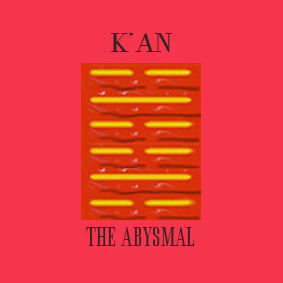
29. K'an; The Abysmal Above;K'an the Abysmal water Below; K'an the Abysmal water |
21st Century | Comparisons |
| This is a doubled trigram and here the
qualities embodied are those of the foundations. In this case the
qualities of the soul within the body. The ethereal and inner. That
part of life our normal senses do not equip us to detect. The realm of
synchronicity. In this realm we cannot deceive. In this realm we
operate to rules imposed by a higher order. The order of the
spheres.
Dangerous pastimes devalue life. Danger is contrary to the feminine of nurturing. It is bad for cultivating anything. When one goes for a large victory usually one is hazarding a great deal. True growth doesn't come from the buccaneer mentality. It comes from the small victories being consolidated and built upon continuously. Yet paradoxically it is the dangerous pastimes which bring out in people the ritualistic aspects of a life taken seriously. When one pursues a dangerous end when others are available, that is foolhardiness of which no good will ultimately come. There are times when one finds oneself in a dangerous situation through no fault then the value of life is near and dear. Then one overcomes by following the path of least resistance, like water, absorbing the movements of the world. Overreaching ambition will rupture the tenuous meniscus of wants and needs. Overreaching ambition entangles one in a thicket of thorny diversions and choices. The only way out is by the right path. |
Line 1 |
Below are the comparative interpretations of a) Legge, b) Willhelm, c) Riefler, d) Crowley
a) in the double defile, and (yet) entering a cavern within it. There will be evil.
b) Repetition of the Abysmal. In the abyss one falls into a pit. Misfortune.
c) Already beneath the deep, he stumbles into a chasm. Ominous.
d) Gorge within gorge, the cavern - do not go!
a) in all the peril of the defile. He will, however, get a little (of the deliverance) that he seeks.
b) The abyss is dangerous. One should strive to attain small things only.
c) All the dangers of the deep confront him. Some relief.
d) Involve not deeplier thy dangerous case!
a) whether he comes or goes (=descends or ascends), confronted by a defile. All is peril to him and unrest. (His endeavours) will lead him into the cavern of the pit. There should be no actions (in such a case).
b) Forward and backward, abyss on abyss. In danger like this, pause at first and wait. Otherwise you will fall into a pit in the abyss. Do not act in this way.
c) The depths confront his on every hand. Everything is dangerous; he never at rest. His struggles will plunge him into the chasm within the deep. Take no action.
d) Peril all round - ba still's the luckiest throw.
a)( at a feast), with (simply) a bottle of spirits, and a subsidiary basket of rice, while (the cups and bowls) are only of earthenware. He introduces his important lessons ( as his ruler's intelligence admits. There will in the end be no error.
b) A jug of wine, a bowl of rice with it; Earthen vessels simply handed in through the window. There is certainly no blame in this.
c) The man is at the feast: just win in a clay cup and rice in a clay bowl. he matches his lessons to the intelligence of his host. No mistakes in the end.
d) Instructing kings, most humble caution show!
a) the water of the defile not yet full, ( sot that it might flow away); but order will (soon) be brought about. There will be no error.
b) The abyss s not filled to overflowing, It is filled only to the rim. No blame.
c) The waters of the deep almost overflow. Order must be brought about. No mistakes.
d) Be patient, time brings order with grave pace.
a) bound with cords of three strands or two strands, and placed in the thicket of thorns. But in three years he does not learn the course for him to pursue. There will be evil.
b) Bound with cords and ropes, Shut in between thorn-hedged prison walls: For three years one does not find the way. Misfortune.
c) He is bound with a heavy rope and thrown into a thicket of thorns. For three years he does not see the way out. Ominous.
d) Bound and beset, bewildered too? What woe!