

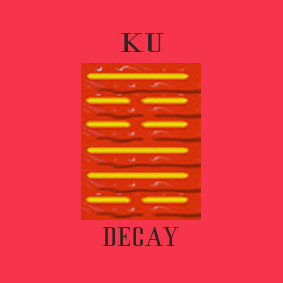
18. Ku Decay Above; Ken Keeping Still mountain Below; Sun the Gentle wind, wood
|
21st Century |
Comparisons |
| This hexagram identifies a universal
condition into which, occasionally, we allow our affairs to fall. No one is
free of this mistake. The folly is not repairing the decay.
Stolid conventionalism arouses decay. What is known is thought to be the safe route, but it is the route of decay. Convention reiterates what is past, but no more. Invariably situations change and the method previously applied has to be continuously tweaked, adjusted and when required renewed. Relying on old methodologies desynchronises one from the flow through the matrix in which one exists. Self reproach serves no end, self- criticism does. Be aware of the error which has allowed the decay to set in but do not be too harsh on yourself. Too sudden an energetic compensation can lead to trouble. However it is better to apply too much energy to solving the problem than too little. Too little is much like allowing the decay to run its course. This can lead to ruination. Many things cannot be solved by one person and need the concerted help of the many. It is a wise person who concedes when such a situation exists. If you recognise the problem but do not act as required to correct the problem then you are negligent. However if you only appear to be not acting but are working on your inner workings then some good may come of it. Nothing is ever completely lost.
|
a) (a son) dealing with the troubles caused by his father. If he be an (able) son, the father will escape the blame of having erred. The position is perilous, but there will be good fortune in the end.
b) Setting right what has been spoiled by the father. If there is a son, No blame rests upon the departed father. Danger. In the end good fortune.
c) The man fixes what his father ruined. If he is successful the father escapes blame. Auspicious at the end after peril.
d) Good sone, repair thy sire's infirmity.
a) (a son) dealing with troubles caused by his mother. He should not (carry) his firm correctness to the utmost.
b) Setting right what has been spoiled by the mother. One must not be too persevering.
c) The man fixes what his mother ruined. Do not go to extremes in keeping to your course.
d) Be gentle with thy mother's frailty, son!
a) (a son) dealing with the troubles caused by his father. There may be some small occasion for repentance, but there will not be any great error.
b) Setting right what has been spoiled by the father. There will be a little remorse. No great blame.
c) The man fixes what his father ruined. Some guilt but no major mistakes.
d) Yea, clear thy father's troubles, every one.
a) (a son) viewing indulgently the troubles caused by his father. If he go forward he will find cause to regret.
b) Setting right what has been spoiled by the father. In continuing one sees humiliation
c) The man overlooks what his father ruined. If you keep to your course you will regret it.
d) Restrain thy course; view them indulgently.
a) (a son) dealing with the troubles caused by his father. He obtains the praise of using (the fit instrument for his work).
b) Setting right what has been spoiled by the father. One meets with praise.
c) The man fixes the ruin bequeathed by his father. His efficiency in doing so brings him praise.
d) Thus gain the praise of thine utility.
a) one who does not serve either king or feudal lord, but in a lofty spirit prefers (to attend) his own affairs.
b) He does not serve kings and princes. Sets himself higher goals.
c) The man sees nothing to be fixed. He remains aloof and cultivates his own spirit.
d) Do what thou wilt, thyself, a slave to none!