

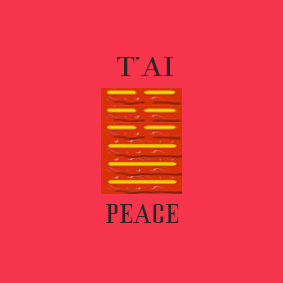
11. T'ai; Peace. Above; K'un the Receptive earth Below; Ch'ien the Creative heaven |
21st Century |
Comparisons |
| Beginning of great things. To remember at the
height of success forbearance with the less fortunate and dull witted.
Crowing one's victories is not seemly. Generosity of spirit extends beyond
coins deposited in a cup or palm. The test of spirit is in the capacity to
be open to change and to exposing elements of ones success to change. Good
will comes from cross pollinations. Good is found in all things if one
looks. There is always a positive angle. As boredom is the product of a
boring mind so waste is the offspring of uselessness. Remember, all things
pass. Good and bad.
But bad will come to pass more quickly and frequently if one is a slacker. Waste no opportunities to grow. Hazard what is necessary for that end, and do not settle into the complacency which comes from success. |
Below are the comparative interpretations of a) Legge, b) Willhelm, c) Riefler, d) Crowley
Hex 11 Line 1: a) grass pulled up, and bringing with it the other stalks with whose roots it is connected. Advance (on the part of its subject) will be fortunate.
b) When the ribbon grass is pulled up, the sod comes with it. Each according to his kind. Undertakings bring good fortune.
c) He pulls up a cluster of wildflowers; the grass comes with it. Auspicious if you advance.
d) Pull up one stalk; and others follow it.
e) Weed with care. Lead by example.
Hex 11 Line 2: a) one who can bear with the uncultivated, will cross the Ho without a boat, does not forget the distant, and has no (selfish) friendships. Thus does he prove himself acting in accordance with the course of the due Mean.
b) Bearing with the uncultured in gentleness, Fording the river with resolution, Not neglecting what is distant. Not regarding one's companions: Thus one may manage to walk in the middle.
c) He can put up with boring men. If there is no boat he can swim the river. He has almost total recall. His friendships are based on love. He certainly keeps to the golden mean!
d) Seek patience, self reliance, love and wit.
e) Suffer fools, be steadfast and circumspect. Serve duty, not interest.
Hex 11 Line 3: a) while there is no state of peace that is not liable to be disturbed, and no departure (of evil men) so that they shall not return, yet when one is firm and correct, as he realises the distresses that may arise, he will commit no error. There is no occasion for sadness at the certainty (of such recurring changes); and in this mood of happiness (of the present) may be (long) enjoyed.
b) No plain not followed by a slope. No going not followed by a return. He who remains persevering in danger Is without blame. Do not complain about this truth; Enjoy the good fortune you still possess.
c) No union without disruption; no departure without return. No mistakes if you keep to your course, foreseeing difficulties. Do not let inevitable changes distress you; savour the joy of the present.
d) Though all things change, rejoice; for that is writ.
e) Understanding things change encourages one to enjoy the now.
Hex 11 Line 4: a) fluttering (down); - not relying o his own rich resources but calling on his neighbours. (They all come) not having received warning, but in the sincerity of their hearts.
b) He flutters down, not boasting of his wealth, Together with his neighbour, Guileless and sincere.
c) He joins with his neighbours and does not rely on his wealth. His neighbours join with him without fearing his power.
d) Call friends to help thee; they may bring thee through.
e) Class means nothing when you love people.
Hex 11 Line 5: a) reminds us of (king) TŒ-yŒ's (rule about the) marriage of his younger sister. By such a course there is happiness and there will be great good fortune.
b) The sovereign I Gives his daughter in marriage. This brings blessing and supreme good fortune.
c) Prince Yi made a new rule when his daughters were married. Happiness. Very auspicious.
d) Remember what Ti Yi thought right and true.
e) Forget about the past and adjust to the new rule.
Hex 11 Line 6: a) the city wall returned into the moat. It is not the time to use the army. (The subject of the line) may, indeed, announce his orders to the people of his own city; but however correct and firm he may be, he will have cause for regret.
b) The wall falls back into the moat. Use no army now. Make your commands known within your own town. Perseverance brings humiliation.
c) The wall joins the moat. The man is not aggressive; he plots with his allies. Some guilt even if you keep to your course.
d) The City's fallen; there's little thou canst do.
e) It is no time to use force when you cannot defend yourself.